CBD products come in many forms, including gummies, oils, tinctures, capsules, softgels, creams, balms, and roll-ons. Although these products may contain the same primary cannabinoid, they can differ greatly in strength, ingredients, THC content, serving size, and intended use.
The right product depends on what you want from the experience. You should consider the format, CBD per serving, spectrum type, THC preference, ingredients, and third-party laboratory results before buying.
This CBD guide gives adults aged 21 and older a practical way to compare CBD products without unsupported promises or medical claims.
Important Notice
Important: This article is for general educational purposes only.It is not medical advice, and retail CBD products should not be used to diagnose, treat, cure, or prevent any disease. Always read product labels, follow manufacturer directions, and consult a qualified healthcare professional if you have questions regarding CBD or other cannabinoids.
CBD Guide in 30 Seconds
CBD is a naturally occurring cannabinoid found in cannabis plants.
Before choosing a CBD product:
- Decide whether you want an oral or topical product.
- Check how much CBD is included per serving.
- Understand the difference between Full Spectrum, Broad Spectrum, and CBD Isolate.
- Review the THC information.
- Read the complete ingredient list.
- Find the Certificate of Analysis (COA).
- Confirm that the batch number matches the product.
- Avoid products that promise guaranteed medical results.
Table of Contents
- What Is CBD?
- CBD vs. THC
- How CBD Interacts With the Body
- Potential Benefits of CBD
- Full-Spectrum, Broad-Spectrum, and CBD Isolate
- CBD and Terpenes
- Common CBD Product Types
- CBD Gummies vs. CBD Oil
- How to Choose a CBD Product
- CBD Dosage for Beginners
- How to Read a CBD Label
- How to Read a CBD Lab Report
- CBD Safety and Side Effects
- Is CBD Legal in Florida?
- Shopping for CBD Near Hallandale Beach
- Frequently Asked Questions
What Is CBD?
CBD stands for cannabidiol. It is one of the many natural compounds, called cannabinoids, found in cannabis plants.
CBD can come from hemp or marijuana. Both plants belong to the cannabis family, but they are treated differently under federal and state laws based largely on their THC content and how the finished product is made and sold.
THC stands for tetrahydrocannabinol. It is the cannabinoid most closely associated with the intoxicating effect, or “high,” produced by marijuana.
CBD by itself does not create that same classic high. However, some CBD products contain THC, especially full-spectrum formulas. A mislabeled or poorly tested product may also contain more THC than expected.
For that reason, shoppers should never rely only on the word “CBD” on the front of a package. The spectrum type, THC information, serving size, ingredient list, and third-party laboratory report all matter.
Under the current federal definition, hemp generally refers to cannabis containing no more than 0.3% delta-9 THC by dry weight. However, meeting the federal definition of hemp does not automatically make every finished CBD product legal or compliant in every state.
CBD vs. THC: What Is the Difference?
CBD and THC are both cannabinoids, but they can affect the body differently.
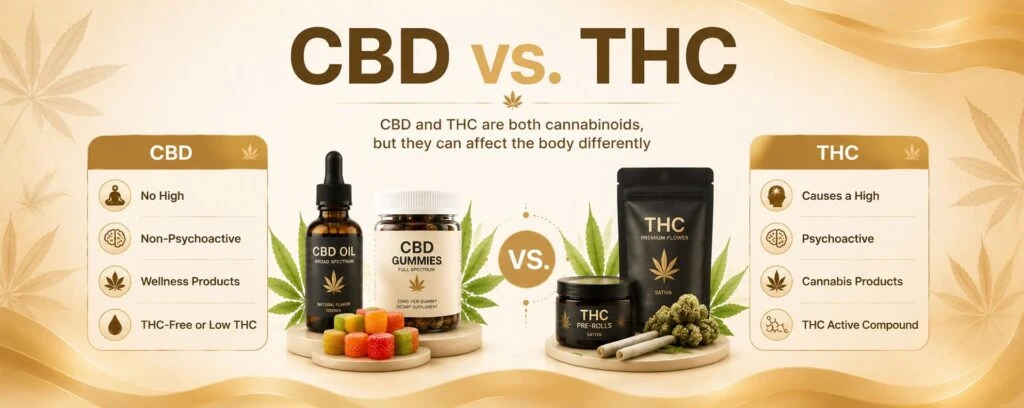
| Topic | CBD | THC |
|---|---|---|
| Full name | Cannabidiol | Tetrahydrocannabinol |
| Intoxicating effect | Does not produce the same classic high by itself | Can produce intoxicating effects |
| Common formats | Gummies, oils, capsules, softgels, and topicals | Edibles, flower, oils, vapes, and other products |
| Presence in CBD products | May be used alone or with other hemp compounds | May appear in full-spectrum products |
| Drug-testing concern | Possible, especially with full-spectrum or mislabeled products | Higher concern |
| Legal status | Depends on the source, formula, and local rules | Varies widely by state and product |
| Product testing | Needed to confirm CBD, THC, and contaminants | Needed to confirm strength and contaminants |
Even a product labeled broad-spectrum or THC-free may carry some drug-testing risk. Laboratory detection limits, manufacturing practices, cross-contamination, repeated use, and inaccurate labels can all affect the outcome.
People who face workplace, legal, athletic, military, probation, or court-ordered drug testing should use extra caution.
How Does CBD Interact With the Body?
The body has a signaling network known as the endocannabinoid system (ECS). Researchers study this system for its role in processes such as mood, sleep, appetite, memory, immune signaling, and the body’s response to discomfort.
The ECS includes naturally produced compounds called endocannabinoids, enzymes that create and break them down, and receptors found throughout the body.
Two commonly discussed receptors are:
- CB1 receptors, which are found mainly in the brain and the central nervous system.
- CB2 receptors, which are found in immune tissues and other parts of the body.
THC can interact directly with cannabinoid receptors, especially CB1 receptors. CBD appears to work differently and may influence several signaling systems rather than strongly attaching to one cannabinoid receptor.
Researchers are still studying these processes. A possible biological interaction does not prove that a retail CBD product treats a medical condition.
What Are the Potential Benefits of CBD?
Many adults explore CBD as part of a routine focused on relaxation, sleep habits, everyday stress, post-workout care, or general wellness. Others use topical CBD products on a specific area of the skin.
However, personal interest and customer experience do not prove that a product will produce a certain result.
The effects of CBD may differ based on:
- The amount used
- Product quality
- CBD spectrum type
- THC content
- Other active ingredients
- Food intake
- Metabolism
- Body composition
- Medication use
- Frequency of use
- Individual sensitivity
Research into many common nonprescription uses remains limited. The FDA has approved one prescription drug containing purified CBD for seizures associated with certain medical conditions. Other retail CBD products have not completed that same drug-approval process.
A store-bought gummy, oil, capsule, or cream should therefore not be described as an approved treatment for anxiety, insomnia, chronic pain, inflammation, or another medical condition.
Some people add CBD to an evening routine. That is different from claiming that CBD treats a sleep disorder. Sleep products may also contain melatonin, herbs, THC, or other ingredients that can change the experience.
The safest approach is to treat CBD as a product category that requires careful comparison rather than a guaranteed answer to a health concern.
Full-Spectrum, Broad-Spectrum, and CBD Isolate
The CBD spectrum describes which hemp compounds are included in a formula.
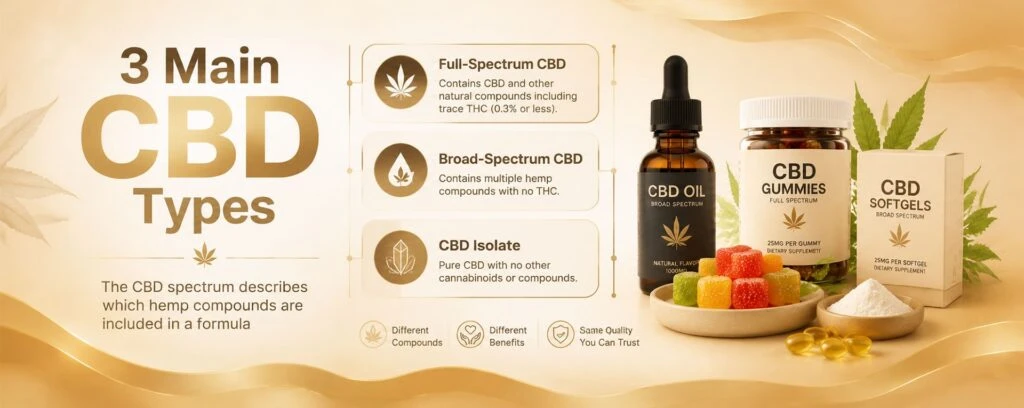
No spectrum type is automatically best for everyone. The right choice depends on your THC preference, drug-testing concerns, ingredient preferences, and comfort level.
Also Read: Full Spectrum vs Broad Spectrum CBD: Key Differences, Benefits, and How to Choose
| CBD Type | What It Usually Contains | Main Consideration | May Suit |
|---|---|---|---|
| Full-spectrum CBD | CBD, other cannabinoids, terpenes, and a permitted amount of THC | May not suit people who want to avoid THC | Adults comfortable with a wider hemp profile |
| Broad-spectrum CBD | CBD and other hemp compounds are usually formulated without detectable THC | Testing is still needed because laboratory limits and formulas vary | Adults who prefer to avoid THC while keeping other hemp compounds |
| CBD isolate | Highly purified CBD without intentionally added THC or other cannabinoids | A simpler formula does not guarantee a negative drug test | Adults looking for a CBD-focused formula |
What Is Full-Spectrum CBD?
Full-spectrum CBD usually contains CBD, additional cannabinoids, terpenes, and trace amounts of THC.
This type may appeal to people who prefer a product containing a wider range of naturally occurring hemp compounds. However, it may not be suitable for anyone who wants to avoid THC.
What Is Broad-Spectrum CBD?
Broad-spectrum products generally contain CBD and other hemp compounds but are processed or formulated to remove THC.
The phrase “THC-free” should still be checked against a current COA. Different laboratories have different detection limits, and poorly manufactured products may not match their labels.
What Is CBD Isolate?
CBD isolate is a highly purified form of CBD. It typically does not intentionally include THC, terpenes, or other cannabinoids.
It may suit people who prefer a simpler formula. However, no nonprescription CBD product can guarantee that a person will pass a drug test.
CBD and Terpenes
Terpenes are aromatic compounds found in hemp and many other plants. They help create a plant’s natural scent and flavor.
Common cannabis-related terpenes include:
- Myrcene, which may have an earthy or herbal aroma.
- Limonene, which often has a citrus-like scent.
- Pinene, which may smell fresh or pine-like.
- Linalool, which often has a floral aroma.
- Caryophyllene, which may have a peppery or spicy profile.
Some full-spectrum and broad-spectrum CBD products naturally retain terpenes. Other products have terpenes added during manufacturing.
Researchers continue studying how terpenes and cannabinoids may interact. However, a terpene’s presence does not prove that the product will deliver a particular wellness result.
When comparing products, check whether the terpenes are naturally retained, added separately, or listed only as flavoring.
Common Types of CBD Products
The product format affects how you measure, use, store, and carry CBD.
Vibe District’s CBD selection may include gummies, oils, tinctures, capsules, softgels, creams, balms, roll-ons, topicals, and nighttime formulas. Availability may change over time.
| Product Type | How It Is Used | Main Advantage | Possible Drawback | May Suit |
|---|---|---|---|---|
| CBD gummies | Chewed and swallowed | Premeasured and portable | Less flexibility when changing the serving | People who want a simple routine |
| CBD oils and tinctures | Measured with a dropper and used as directed | Greater control over the serving | Requires careful measurement | People who want serving flexibility |
| CBD capsules and softgels | Swallowed with water | Familiar, discreet, and mess-free | Difficult to adjust in small amounts | People who prefer pill-style products |
| CBD creams and balms | Applied to the skin | Easy to apply to a selected area | Cannot be compared directly with an oral serving | People who prefer external use |
| CBD roll-ons | Rolled onto the skin | Portable and less messy | May contain menthol or warming ingredients | People who want a convenient topical application |
| CBD sleep products | Used according to the package directions | Designed for an evening routine | May contain melatonin, THC, or herbs | Adults comparing nighttime products |
CBD Gummies
CBD gummies provide a fixed amount in each piece. They require no measuring and are easy to carry.
Check the amount of CBD per gummy rather than only looking at the total amount in the jar. Also, review the sugar content, THC level, flavoring, sweeteners, and other active ingredients.
CBD Oils and Tinctures
CBD oil is commonly sold in a bottle with a dropper. A clearly marked dropper may allow more control over the amount used.
Check whether the label provides CBD per milliliter, per full dropper, or per partial dropper. Never assume every dropper contains the same amount.
CBD Capsules and Softgels
Capsules and softgels provide a familiar, premeasured format. They may appeal to people who prefer a product that looks and feels similar to a standard supplement.
Because the amount is fixed in each capsule, adjusting the serving in small steps may be difficult.
CBD Creams, Balms, and Roll-Ons
CBD topicals are applied externally. They may contain menthol, camphor, essential oils, botanical extracts, or warming and cooling ingredients.
An oral product and a topical product should not be compared only by their total milligram amounts. They are used differently and may contain very different formulas.
CBD Gummies vs. CBD Oil
The choice between CBD gummies and CBD oil usually comes down to simplicity versus serving control.
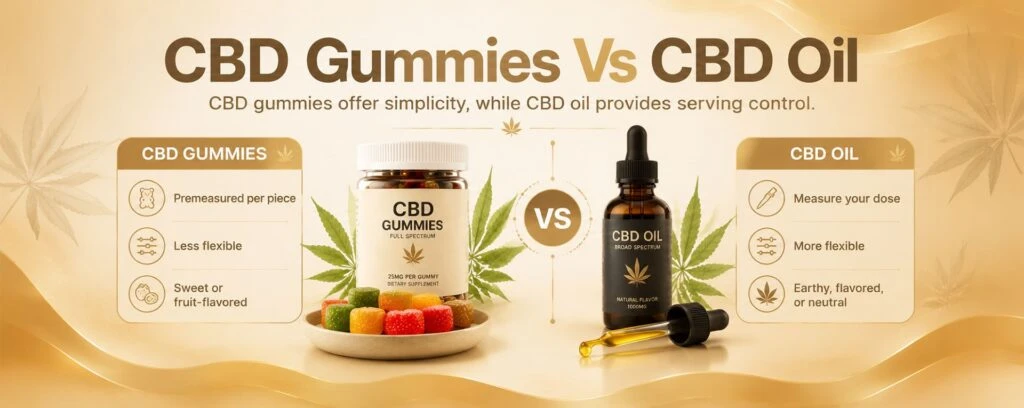
Gummies provide a fixed amount in each piece. Oil may offer greater flexibility when the label and dropper have clear measurements.
| Feature | CBD Gummies | CBD Oil |
|---|---|---|
| Serving consistency | Usually premeasured per piece | Depends on careful measurement |
| Serving adjustment | Less flexible | More flexible with a marked dropper |
| Flavor | Often sweet or fruit-flavored | May be earthy, neutral, or flavored |
| Convenience | No measuring required | Requires a bottle and dropper |
| Portability | Easy to carry | Must be stored carefully to prevent leaks |
| Digestion | Swallowed and digested | Follow the label’s directions |
| Label information | Check the CBD per gummy | Check the CBD per milliliter or dropper |
| Beginner appeal | Useful for a fixed routine | Useful for greater control |
Choose CBD Gummies When You Want:
- A premeasured serving
- No dropper or measuring
- A portable product
- A familiar edible format
- A sweet or fruit-flavored option
Choose CBD Oil When You Want:
- More control over the amount
- A wider range of strengths
- The ability to measure smaller changes
- A flavored or unflavored formula
- Fewer ingredients than some gummies
Food intake, metabolism, product formula, amount, and personal sensitivity may affect the experience. Avoid sellers that promise an exact onset time, guaranteed duration, or identical results for everyone.
How to Choose the Right CBD Product
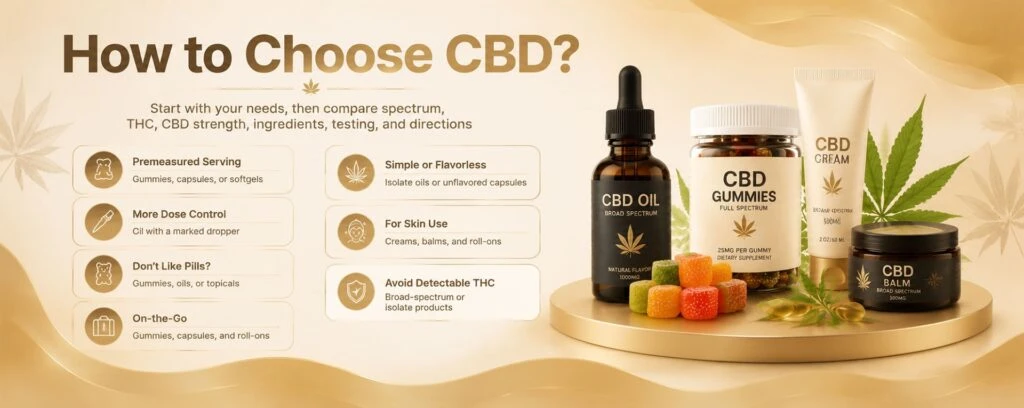
Begin with how you want to use the product. Then compare the spectrum type, THC content, CBD per serving, ingredients, testing, and package directions.
Choose by Product Format
- For a premeasured serving: Consider gummies, capsules, or softgels.
- For greater serving control: Consider an oil with a clearly marked dropper.
- For people who dislike swallowing capsules: Consider gummies, oils, creams, or roll-ons.
- For external use: Compare creams, balms, gels, and roll-ons.
- For convenient travel or on-the-go use: Consider gummies, capsules, softgels, or roll-ons.
Choose by THC Preference
- Comfortable with trace THC: A tested full-spectrum product may fit your preference.
- Prefer to avoid THC: Compare broad-spectrum and CBD isolate products with current laboratory results.
- Concerned about drug testing: Understand that no CBD product can guarantee a negative result.
Choose by Ingredients
Check the complete formula, not only the CBD amount.
CBD products may also contain:
- THC
- Melatonin
- Caffeine
- Menthol
- Camphor
- Essential oils
- Herbs
- Artificial sweeteners
- Added sugar
- Allergens
- Coconut-derived carrier oils
- Flavoring agents
Avoid combining several CBD products until you understand the amount of CBD and every other active ingredient in each formula.
Choose by Product Quality
A trustworthy product should have:
- Clear CBD per serving
- Clear THC information
- A current batch number
- An expiration or best-by date
- A complete ingredient list
- Suggested-use instructions
- Required warnings
- Manufacturer or distributor contact details
- A matching third-party COA
- Clear storage directions
💡 Quick Takeaway
The best CBD product is not automatically the strongest or most expensive one. It is the product whose format, ingredients, strength, THC level, and testing fit your needs.
How Much CBD Should a Beginner Take?
There is no single over-the-counter CBD dosage that works for everyone. Retail formulas differ, and the FDA has not established one standard consumer dose for unapproved CBD products.
A careful approach focuses on understanding the label.
CBD Dosage Tips for Beginners
- Read the suggested-use section.
- Find the CBD amount per serving.
- Do not confuse total container strength with CBD per serving.
- Begin with the lowest practical amount permitted by the label.
- Make changes gradually.
- Do not stack several CBD products at once.
- Record the product, amount, time used, and other active ingredients.
- Speak with a qualified healthcare professional when you use medication or manage a medical condition.
CBD Label Math Example
Suppose a bottle contains:
- 1,500 mg total CBD
- 30 listed servings
The calculation is:
This calculation only explains the label. It does not mean 50 mg is appropriate for every person.
For gummies, divide the total CBD by the number of pieces when the label does not clearly state CBD per gummy.
For oils, determine whether the label lists CBD per bottle, per milliliter, or per full dropper.
For beginners, a clearly labeled, premeasured product may be easier to understand. An oil may offer more flexibility, but it also requires more careful measurement.
How to Read a CBD Product Label
A good CBD label should answer essential questions without forcing you to guess.
Check for:
- Total CBD in the package
- CBD per serving
- Serving size
- Number of servings
- Full-spectrum, broad-spectrum, or isolate wording
- THC information
- Complete ingredient list
- Allergen information
- Batch or lot number
- Expiration or best-by date
- Suggested-use directions
- Storage instructions
- Required warnings
- Manufacturer or distributor details
- QR code or web address for laboratory results
Total CBD vs. CBD per Serving
A large number on the front of a bottle often refers to the CBD in the entire package.
For example, “1,500 mg CBD” may mean:
- 1,500 mg in the full bottle
- 50 mg in each of 30 servings
- Another amount based on the container size and serving count
It usually does not mean that one gummy, capsule, or dropper contains 1,500 mg.
When the amount per serving is unclear, pause before purchasing.
Do Not Judge CBD Only by Milligrams
A higher total milligram number does not always mean a stronger serving. It may simply mean:
- A larger bottle
- More gummies
- More capsules
- More servings
- A more concentrated formula
Compare CBD per serving and serving size before comparing prices.
How to Read a CBD Lab Report
A certificate of analysis, commonly called a COA, is a laboratory report connected to a specific product or batch.
The COA helps you compare the package claims with laboratory results.
A Useful CBD COA Should Include:
- Product name
- Batch or lot number
- Testing date
- CBD potency
- THC results
- Other cannabinoid results
- Laboratory name
- Testing method
- Heavy-metal results
- Pesticide results
- Residual-solvent results
- Microbial results
- Pass or fail information where applicable
Match the COA to the Product
The batch number on the report should match the batch number on the package.
A QR code that opens a brand homepage, general testing page, or unrelated report is not enough. It should lead to the report for the correct product and batch.
Also, check the testing date. An old report for a different batch does not verify the product currently in your hand.
What Does “Third-Party Tested” Mean?
Third-party testing means a laboratory separate from the brand or manufacturer tests the product.
However, the phrase alone is not proof of quality. Shoppers should still review:
- The laboratory’s name
- The report date
- The matching batch number
- The cannabinoid results
- The contaminant panels
- Whether the complete report is available
A current, batch-matched COA provides stronger information than a front-label badge stating “lab tested.”
CBD Buying Checklist
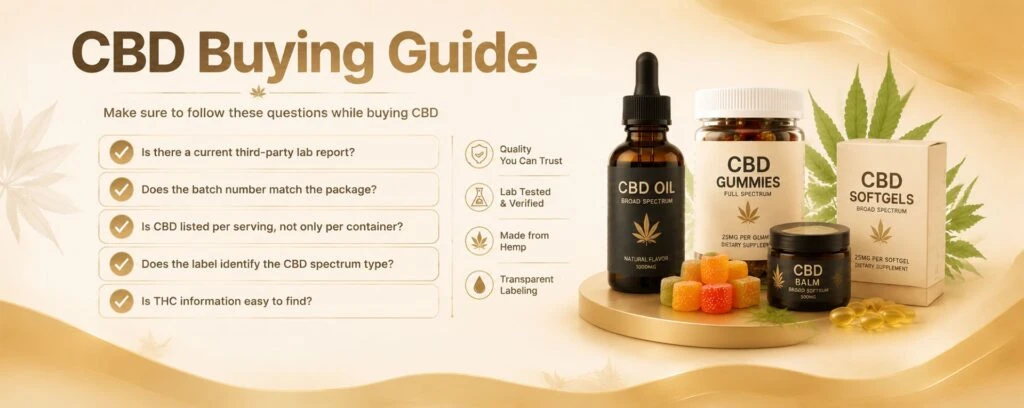
Before purchasing CBD, ask:
- Is there a current third-party laboratory report?
- Does the report match the package batch number?
- Is CBD listed per serving?
- Is the total number of servings clear?
- Does the label identify the spectrum type?
- Is THC information easy to find?
- Are all ingredients listed?
- Are allergens disclosed?
- Is there an expiration or best-by date?
- Does the package include clear directions?
- Is the container suitable for the product?
- Can you find the manufacturer’s contact information?
- Does the marketing avoid cure or treatment promises?
- Does the format fit your routine?
- Are shipping, pickup, age, and return terms clear?
Claims such as “made in the USA,” “organic,” or “lab tested” should only appear when the company can support them.
CBD Safety, Side Effects, and Drug Interactions
CBD is not risk-free. The FDA and NCCIH continue to warn consumers about unanswered safety questions, possible side effects, medication interactions, liver-related concerns, and inaccurate product labels.
Possible side effects may include:
- Drowsiness
- Reduced alertness
- Digestive discomfort
- Diarrhea
- Appetite changes
- Mood changes
- Medication interactions
- Possible liver-related effects
The chance of an unwanted reaction may change based on the amount, frequency, product formula, other cannabinoids, medication use, and personal health.
Talk With a Healthcare Professional Before Using CBD If You:
- Take prescription medication
- Take over-the-counter medication
- Use herbs or dietary supplements
- Have a liver condition
- Have another medical condition
- Plan to use multiple CBD products
- Are you preparing for a drug test
- Have experienced reactions to cannabis products
- Are you pregnant or breastfeeding
The FDA strongly advises against using CBD, THC, or marijuana during pregnancy or while breastfeeding.
CBD can affect how some medications work. A healthcare professional or pharmacist may help identify possible interactions.
Do not drive, operate machinery, or perform safety-sensitive work until you understand how a product affects you. This is especially important when the formula contains THC, melatonin, or another ingredient that may cause drowsiness.
Stop using the product and seek medical attention if you experience a severe or unexpected reaction.
Do not use CBD to delay professional medical care.
Can CBD Cause a Positive Drug Test?
It is possible.
Full-spectrum products may contain THC. Broad-spectrum and isolate products may also create risk when:
- The label is inaccurate
- THC was not removed as claimed
- Cross-contamination occurred
- The person uses the product frequently
- The laboratory’s detection limit differs from the drug test
- The product contains another detectable cannabinoid
No CBD seller should promise that a product is guaranteed to be drug-test safe.
Is CBD Legal in Florida?
Florida allows qualifying hemp and hemp-extract products when they meet applicable state and federal requirements.
Florida rules may cover product testing, packaging, labeling, child-resistant containers, batch identification, and how hemp products intended for human consumption are sold. State enforcement requirements have continued to change, including amended rules enforced from June 16, 2025.
For qualifying hemp-extract products, shoppers should look for information such as:
- A batch or lot number
- Cannabinoid amounts
- A matching certificate of analysis
- A QR code or link to test results
- An expiration or best-by date
- Required warning and labeling information
- Compliant packaging
Florida restricts the sale of certain hemp products intended for ingestion or inhalation to people under 21.
Laws, administrative rules, and enforcement practices can change. Check current Florida requirements before purchasing, carrying, shipping, or traveling with CBD.
Calling a product “hemp” does not automatically make every formula legal in every location. Rules may also differ outside Florida.
Where Can You Shop for CBD Near Hallandale Beach?
Vibe District is a smoke and wellness store located at:
4 W Hallandale Beach Blvd
Hallandale Beach, Florida
The available CBD selection may include:
- CBD gummies
- CBD oils
- CBD tinctures
- CBD capsules
- CBD softgels
- CBD creams
- CBD roll-ons
- Other topical products
- Nighttime formulas
Customers can browse available CBD products online or compare product labels in person.
The Hallandale Beach location may also be convenient for adults shopping from nearby areas such as:
- Hollywood
- Aventura
- Pembroke Park
- Dania Beach
- Miami Gardens
- North Miami Beach
Product selection can change based on inventory and demand. Check online availability or contact the store before visiting when you are looking for a specific brand, strength, flavor, or product type.
Still Not Sure Which CBD Product Fits Your Routine?
Start with three questions:
- Do you want an oral or topical product?
- Do you want to avoid THC?
- Do you prefer a fixed serving or flexible measurement?
Choose gummies, capsules, or softgels when you want a premeasured option. Consider oil when you want more control over the amount. Compare creams, balms, and roll-ons when you prefer external use.
After choosing a format, review the CBD per serving, spectrum type, ingredients, THC level, and batch-matched COA.
Final Takeaway
The right CBD product depends on more than the largest milligram number on the package.
Compare:
- Product format
- CBD per serving
- Number of servings
- Full-spectrum, broad-spectrum, or isolate
- THC content
- Additional ingredients
- Laboratory testing
- Batch information
- Package directions
- Drug-testing concerns
- How the product fits your routine
The label and COA should be clear before price, flavor, or marketing claims influence your decision.
Use this CBD guide as an educational starting point rather than medical advice. Take time to compare products, ask questions, and choose options with transparent labels and current test results.
Adults aged 21 and older can browse Vibe District’s CBD collection online or visit the Hallandale Beach store to compare available options.
Medical Disclaimer
This content is provided for general educational and informational purposes only. It is not intended to replace advice from a physician, pharmacist, or other qualified healthcare professional.
CBD products are not intended to diagnose, treat, cure, or prevent any disease. Speak with a healthcare professional before using CBD, especially if you take medication, use dietary supplements, have a medical condition, are pregnant, are breastfeeding, or expect to undergo drug testing.
Frequently Asked Questions
What Is CBD?
CBD stands for cannabidiol. It is a cannabinoid found in cannabis plants. It differs from THC and does not produce the same classic intoxicating high by itself.
Does CBD Make You Feel High?
CBD alone is not the cannabinoid mainly responsible for marijuana’s intoxicating effect. However, full-spectrum or mislabeled CBD products may contain THC and could produce unwanted effects.
What Type of CBD Is Best for Beginners?
There is no single best CBD type for every beginner. A clearly labeled gummy, capsule, or softgel may be easier because it offers a premeasured amount. Oil may suit people who want more control over the serving.
Are CBD Gummies Better Than CBD Oil?
Neither format is better for everyone. Gummies provide a fixed amount and require no measuring. Oil offers greater serving flexibility when the label and dropper are clear.
How Much CBD Should a Beginner Use?
Follow the product directions and begin with the lowest practical amount allowed by the label. Check the CBD per serving instead of relying only on the total milligrams shown on the front.
Speak with a healthcare professional when you use medication, have a medical condition, or are unsure about combining CBD with other products.
What Is Full-Spectrum CBD?
Full-spectrum CBD generally contains CBD, additional cannabinoids, terpenes, and a permitted amount of THC. It may not suit people who want to avoid THC or who face drug testing.
What Is Broad-Spectrum CBD?
Broad-spectrum CBD generally contains CBD and other hemp compounds but is formulated to remove THC. A current COA is still needed to confirm the laboratory results.
What Is CBD Isolate?
CBD isolate is a highly purified form of CBD without intentionally added THC or other cannabinoids. It offers a simpler formula, but it cannot guarantee a negative drug test.
Can CBD Show Up on a Drug Test?
Yes, it is possible. Full-spectrum products may contain THC, while mislabeled, contaminated, or frequently used products can also create risk.
Does CBD Expire?
CBD products usually include an expiration or best-by date. Heat, light, air, moisture, and poor storage may affect product quality. Follow the storage instructions and avoid using a product that looks, smells, or tastes unusual.
How Should CBD Oil Be Stored?
Keep CBD oil tightly closed and store it according to the label. A cool, dry place away from direct sunlight is commonly recommended. Do not leave the bottle in a hot vehicle.
What Does Third-Party Tested Mean?
Third-party tested means an outside laboratory analyzed the product. Shoppers should still confirm that the batch number matches and review the cannabinoid and contaminant results.
Is Hemp CBD the Same as Marijuana CBD?
The CBD molecule may be the same, but the plant source, THC content, finished formula, and legal treatment can differ. Hemp is legally defined largely by its delta-9 THC concentration.
Can You Travel With CBD?
Travel rules depend on the product, destination, transportation method, and local law. Check the THC content and current laws for every state or country involved before traveling.
Is CBD Legal in Florida?
Qualifying hemp-extract products may be sold in Florida when they meet current testing, packaging, labeling, age, and retail requirements. Laws and enforcement practices can change, so verify current rules before buying or traveling.
Can You Use CBD Every Day?
People use CBD in different ways, but long-term safety questions remain. Frequency does not remove the risk of side effects, drug interactions, THC exposure, or inaccurate labeling. Discuss regular use with a healthcare professional.
Can CBD Interact With Medication?
Yes. CBD may change how certain medications are processed and may increase or decrease their effects. Speak with a physician or pharmacist before using CBD with prescription or over-the-counter medication.
Can Pregnant or Breastfeeding People Use CBD?
The FDA advises against using CBD, THC, or marijuana during pregnancy and breastfeeding because of potential risks and limited safety information.
What Should a CBD Lab Report Show?
A useful COA should show the product and batch number, test date, CBD potency, THC results, other cannabinoids, laboratory information, and relevant contaminant testing.
References
- U.S. Food and Drug Administration: What You Need to Know About Products Containing Cannabis or CBD
- U.S. Food and Drug Administration: FDA Regulation of Cannabis and Cannabis-Derived Products, Including CBD
- U.S. Food and Drug Administration: CBD Use During Pregnancy or Breastfeeding
- National Center for Complementary and Integrative Health: Cannabis, Marijuana, and Cannabinoids—What You Need to Know
- National Institutes of Health: Research Into Minor Cannabinoids and Terpenes
- Florida Department of Agriculture and Consumer Services: Hemp Food Rule Enforcement Notice
- Florida Statutes Section 581.217: State Hemp Program
- Florida Administrative Code Rule 5K-4.034: Hemp Extract for Human Consumption