CBD Oil vs Gummies: Quick Comparison
| Factor | CBD Oil | CBD Gummies |
|---|---|---|
| Serving control | Adjustable by mL or dropper measurement | Pre-measured milligrams per gummy |
| Absorption route | Held in the mouth, then largely swallowed | Swallowed and absorbed through the digestive tract |
| Timing | May be perceived sooner, but controlled data show large variation | More dependent on digestion, meals and formulation |
| Cost comparison | Often easier to compare by mg per mL | Compare price against total mg in the jar |
| Taste | Natural hemp or flavored oil | Usually sweet and flavored |
| Best fit | People who want adjustable servings | People who want portability and consistency |
Simple answer: Choose CBD oil if precise serving control matters most. Choose CBD gummies if you prefer a pre-measured, portable routine.
What Are CBD Oil and CBD Gummies?
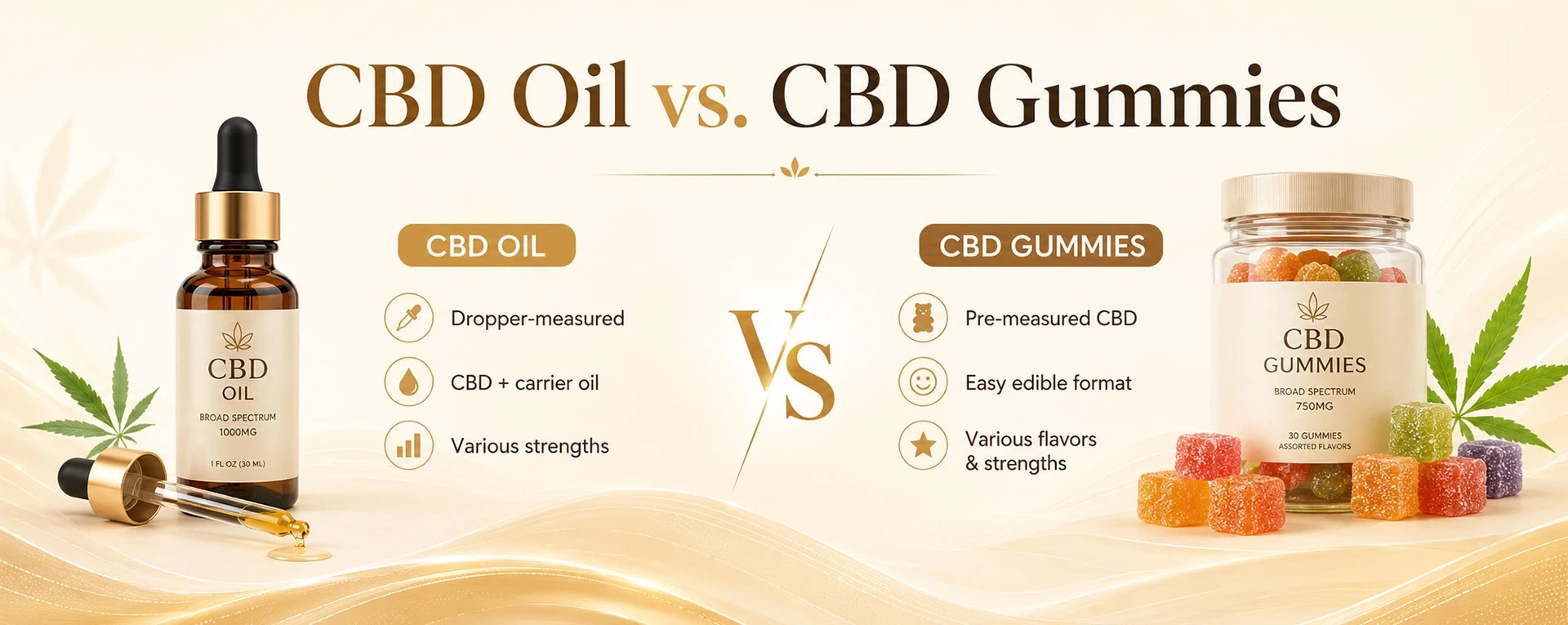
CBD oil combines cannabidiol-rich hemp extract with a carrier oil, commonly MCT, hemp seed, olive, or another food-grade oil. Most tincture-style products are measured with a dropper. Browse Vibe District’s CBD oils and tinctures to compare current strengths and formulas.
CBD gummies are edible products with a stated amount of CBD per piece. They may also contain sugar, pectin or gelatin, flavoring, melatonin, botanicals, or other cannabinoids. See the current CBD gummies selection for different formats and strengths.
Full-Spectrum CBD, Broad-Spectrum CBD and CBD Isolate
- Full-spectrum CBD: contains CBD plus other naturally occurring hemp compounds, potentially including a legally permitted amount of delta-9 THC.
- Broad-spectrum CBD: keeps multiple hemp compounds while reducing or removing THC, depending on the formulation and test result.
- CBD isolate: purified CBD with most other cannabinoids and plant compounds removed.
The term entourage effect describes the hypothesis that cannabinoids, terpenes, and other plant compounds may influence one another’s effects. A 2024 review found the idea biologically plausible in some settings but concluded that more clinical trials are needed, especially for terpene-related claims. In practice, full-spectrum CBD should not be assumed to work better than broad-spectrum CBD or CBD isolate for every person.
Bioavailability: Why the Percentages Are Not as Simple as They Look
Bioavailability means the proportion of a dose that reaches systemic circulation. Many CBD comparison pages publish fixed percentages for oil and gummies, but human evidence does not support one universal number for consumer products. A systematic review of human CBD pharmacokinetics found that absolute bioavailability had not been established for most non-inhaled routes.
More importantly, a randomized crossover study in eight healthy men compared about 69 mg of CBD delivered as sublingual oil with the same oil swallowed in gelatin capsules. Peak CBD concentrations were 28.0 versus 24.0 ng/mL, and the median time to peak was about 4 hours in both conditions. The researchers found no meaningful pharmacokinetic difference between the two routes. That is a useful reminder that holding oil under the tongue does not guarantee dramatically greater absorption.
Food can matter even more. In a 2025 crossover study of 11 adults given a CBD-rich extract, a high-fat meal increased peak CBD concentration by a factor of 17.4 and overall exposure by a factor of 9.7 compared with fasting. This does not mean everyone should pair CBD with a high-fat meal. It shows why timing and absorption can vary so much from one situation to another.
Onset and Duration: Treat Timing Claims as Estimates
You will often see oil described as taking effect in roughly 15 to 30 minutes and gummies in 30 to 90 minutes. Those ranges can be useful as general expectations, but they are not guaranteed pharmacokinetic rules. Perceived onset is not the same thing as the time of peak blood concentration. Meals, dose, product design, metabolism, and whether an oil is swallowed quickly can all change timing.
The same caution applies to duration. A product that absorbs more slowly may feel more gradual, but a lower bioavailability percentage does not automatically mean shorter effects. Compare how you respond to a consistent serving instead of assuming one format will always last longer.
Also Read: How Long Does CBD Take to Work? Onset Times, Effects, and What to Expect
Carrier Oils, Water-Soluble CBD and Nanoemulsions
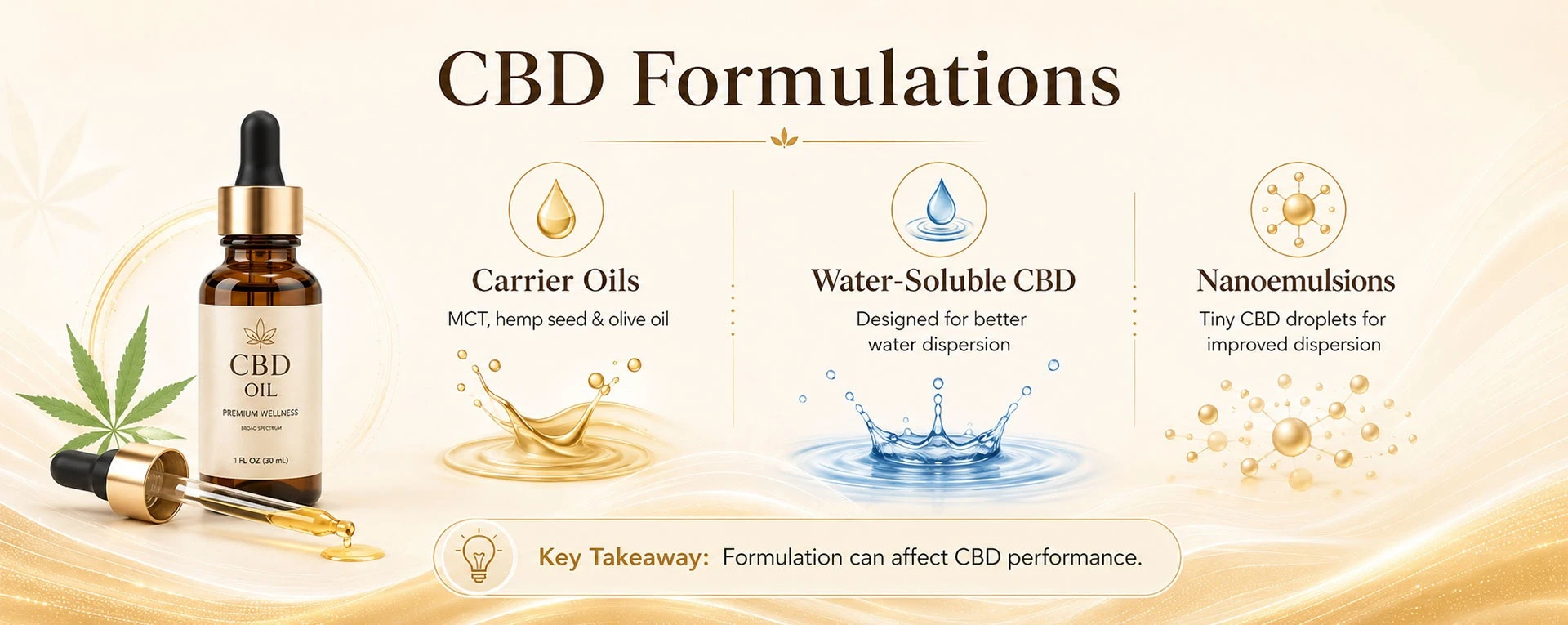
Carrier oil is not just filler. CBD is highly lipophilic, meaning it dissolves in fat better than water. A 2022 animal study found that the composition of vegetable oils changed CBD’s intestinal lymphatic transport and systemic exposure. That suggests the carrier can matter, but it does not prove that MCT, hemp seed oil, or olive oil is universally best in humans.
Water-dispersible and nanoemulsified CBD products are designed to improve dispersion of this poorly water-soluble compound. In a 2023 rat study, one oral nanoemulsion reached calculated CBD bioavailability of 18.6% at 6 hours and 25.4% at 24 hours. The result is promising for formulation science, but it came from rats and one specific technology. A label saying “water-soluble” does not guarantee better performance by itself.
CBD Dosage and Cost: Compare Milligrams, Not Package Size
There is no FDA-established universal CBD dosage for over-the-counter wellness products. Start by reading the milligrams per serving and the manufacturer’s directions. If you take prescription medication or use CBD for a diagnosed condition, discuss the product with a healthcare professional before changing your routine.
For oil, calculate concentration with total CBD mg ÷ bottle mL = CBD mg per mL. A 1,500 mg bottle containing 30 mL averages 50 mg per mL. For gummies, divide total CBD by the number of pieces when the label does not already show mg per gummy.
To compare value, use price ÷ total CBD mg × 100 = cost per 100 mg CBD. Oil is often cost-effective when you want flexible dosing, while gummies add convenience, flavoring and pre-measured servings. The better value is the product you can use consistently without wasting servings.
CBD for Sleep, Anxiety and Pain: What the Research Actually Shows
CBD for sleep
A randomized 2024 pilot trial studied 30 adults with primary insomnia. Participants received 150 mg of CBD or placebo nightly. CBD performed similarly to placebo for most sleep outcomes. If you are shopping for CBD for sleep, also check whether a gummy or tincture contains melatonin or another active ingredient, because that changes the comparison.
CBD for anxiety
A 2024 systematic review included 11 randomized controlled trials evaluating CBD and anxiety disorders. Results were mixed and sometimes contradictory because doses and study designs differed. CBD for anxiety remains an area of active research, not a settled over-the-counter treatment claim.
CBD for pain
A 2024 review reported pain reductions of roughly 42% to 66% in many included studies, but some products combined CBD with THC and the patient populations varied. Those numbers should not be read as a promise that ordinary CBD for pain products will produce the same result.
Can You Use CBD Oil Topically?
An ingestible tincture and a topical CBD product are not automatically interchangeable. If localized application is your goal, choose a product specifically labeled for topical use and follow its directions. Topical creams, balms and massage oils are formulated for skin application, while oral tinctures are designed around ingestion and serving measurement.
Can You Use CBD Oil and Gummies Together?
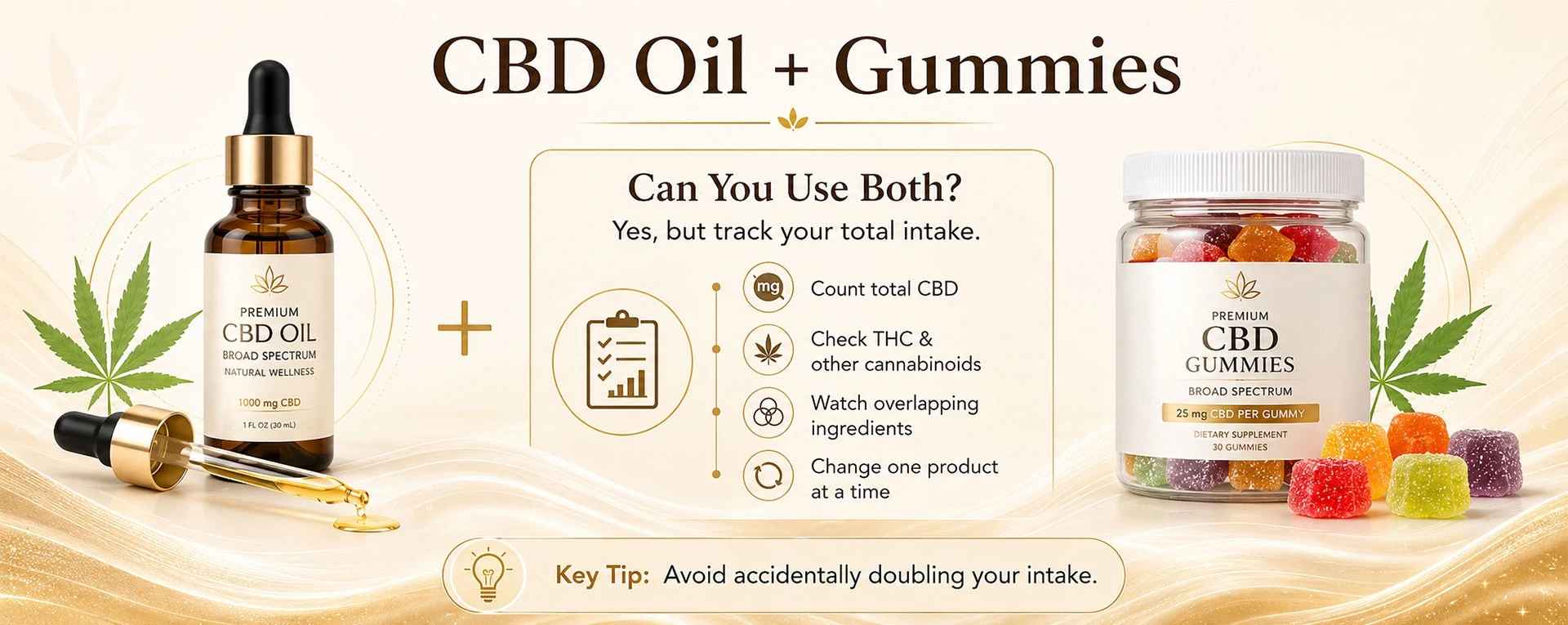
Some adults use both formats because oil allows adjustable servings while gummies are convenient later in the day. Using both does not automatically improve results. The main risk is losing track of total intake or accidentally doubling up on added ingredients such as melatonin.
- Count the total CBD milligrams from both products.
- Check whether both contain THC or other cannabinoids.
- Avoid stacking products with overlapping sleep or botanical ingredients without understanding the combined amount.
- Change one variable at a time so you can tell what is affecting your experience.
Safety, Medication Interactions and Product Quality
The FDA warns that CBD can cause drowsiness, gastrointestinal effects, liver injury, and interactions with other medications. CBD can affect drug-metabolizing pathways, so speak with a doctor or pharmacist if you take prescription medicine. The FDA also advises avoiding CBD during pregnancy and breastfeeding.
Before buying CBD oil or gummies, check the certificate of analysis. Look for the batch number, CBD amount, THC result, and contaminant panels. In Florida, hemp extract sold at retail is subject to testing and labeling requirements under Section 581.217. A proposed 2026 bill that would have changed major hemp rules died in the Senate Agriculture Committee, so shoppers should rely on the current statute and current batch documentation.
CBD Oil vs Gummies: Which Should You Choose?
- Choose CBD oil when adjustable servings and concentration control matter most.
- Choose CBD gummies when you want pre-measured servings, portability, and easier flavor.
- Choose full-spectrum CBD when you intentionally want a broader hemp profile and are comfortable with the tested THC content.
- Choose broad-spectrum CBD or CBD isolate when minimizing THC is a priority, then verify the current COA.
- Compare cost per 100 mg instead of judging value by bottle or jar size.
To compare real options, browse all CBD products at Vibe District, explore CBD gummies, review CBD oils and tinctures, or read the Vibe District CBD guide. If calm and relaxation are your main shopping goal, you can also browse CBD for calm and relaxation.
CBD Oil vs Gummies FAQs
Which is better, CBD oil or CBD gummies?
CBD oil is better for adjustable serving sizes. CBD gummies are better for convenience and pre-measured servings. The best choice depends on formulation, dose, lifestyle, and personal response.
Is CBD oil stronger than gummies?
Not automatically. Compare the CBD milligrams per serving. A higher-dose gummy can contain more CBD than a smaller serving of oil.
Do CBD gummies absorb less than CBD oil?
Gummies go through gastrointestinal digestion, but fixed oil-versus-gummy bioavailability percentages can be misleading. Human research shows that formulation, food, and how oil is used can strongly affect exposure.
How long do CBD oil and gummies take to work?
Oil is often described as having a quicker perceived onset, while gummies depend more on digestion. Exact timing varies, and controlled pharmacokinetic data do not support one universal onset time for every product.
Can CBD interact with medications?
Yes. CBD can change how some medicines are metabolized and may increase side-effect risks. Ask a doctor or pharmacist before combining CBD with prescription medication.
Can you take CBD oil and gummies on the same day?
Some adults do, but total CBD and any added cannabinoids or ingredients should be counted across both products. Using two formats is not automatically more effective.
Shop CBD at Vibe District
Vibe District carries CBD gummies, oils, tinctures and other hemp wellness products in Hallandale Beach. Compare labels and current lab information online, or visit the Vibe District store at 4 W Hallandale Beach Blvd, Hallandale Beach, FL 33009.
Sources
- Cannabidiol oil as sublingual drops versus oral capsules, randomized crossover study
- 2025 high-fat meal and CBD bioavailability study
- 2024 review of the cannabis entourage effect
- 2022 study of carrier oils and CBD lymphatic transport
- 2023 CBD nanoemulsion bioavailability study in rats
- FDA guidance on CBD safety and interactions
- Florida Statutes Section 581.217