This article is for general education. It is not medical, legal, or employment advice. CBD can interact with medicines, so speak with a qualified healthcare professional before use if you take prescriptions or have a medical condition.
If you use CBD, an upcoming drug screening can make one question feel especially urgent: how long does CBD stay in your system? The answer is a range, not a single number. A one-time dose may be processed within a few days, while frequent use, larger servings, and certain testing methods can extend the detection window to several weeks.
There is also an important distinction between CBD itself and the THC that may be present in some hemp products. Most routine workplace screens look for THC metabolites rather than CBD. That means the product’s cannabinoid profile, testing history, and label accuracy matter just as much as your own CBD metabolism.
Quick read: Research-based estimates place the CBD half-life at 18 to 32 hours after a single dose and 2 to 5 days with repeated use. A specific CBD detection window may range from 3 to 30 days in urine, several hours to 1 week in blood, up to 72 hours in saliva, and up to 90 days in hair. These are broad estimates, not guaranteed test results. Standard drug screens usually target THC, so the main concern is trace THC in full-spectrum or inaccurately labeled products.
How long does CBD stay in your system? A quick answer
The answer depends on what is being tested. CBD does not behave the same way in blood, urine, saliva, and hair, and laboratory sensitivity can vary. The table gives practical ranges from pharmacokinetic research and testing guidance.
| Test type | Occasional use | Frequent use |
|---|---|---|
| Urine | 3 to 7 days | Up to 30 days |
| Blood | Several hours to 1 to 2 days | Up to 1 week |
| Saliva | Up to 24 hours | Up to 72 hours |
| Hair | Up to 90 days | Up to 90 days |
These estimates are not a promise that a test will be negative. A test may use a different cutoff or detect a product contaminant rather than CBD. If testing has consequences, review the applicable policy before using any cannabinoid product.
What is CBD?
CBD, short for cannabidiol, is a cannabinoid found in cannabis plants, including hemp. Unlike THC, or tetrahydrocannabinol, CBD is not the compound primarily responsible for the intoxicating high associated with marijuana. It is sold in oils, tinctures, gummies, capsules, vapes, creams, and roll-ons.
The label matters because products with the same CBD name can contain different cannabinoid profiles:
- Full-spectrum CBD contains CBD and other naturally occurring hemp compounds. It may also contain THC within the federal hemp threshold of no more than 0.3% THC by dry weight.
- Broad-spectrum CBD contains multiple hemp compounds and is processed to remove or reduce THC. A batch Certificate of Analysis is the best way to confirm the tested profile.
- CBD isolate is a highly refined form of CBD with most other cannabinoids removed. The finished product can still contain other ingredients, so review the complete label.
CBD half-life and CBD metabolism explained
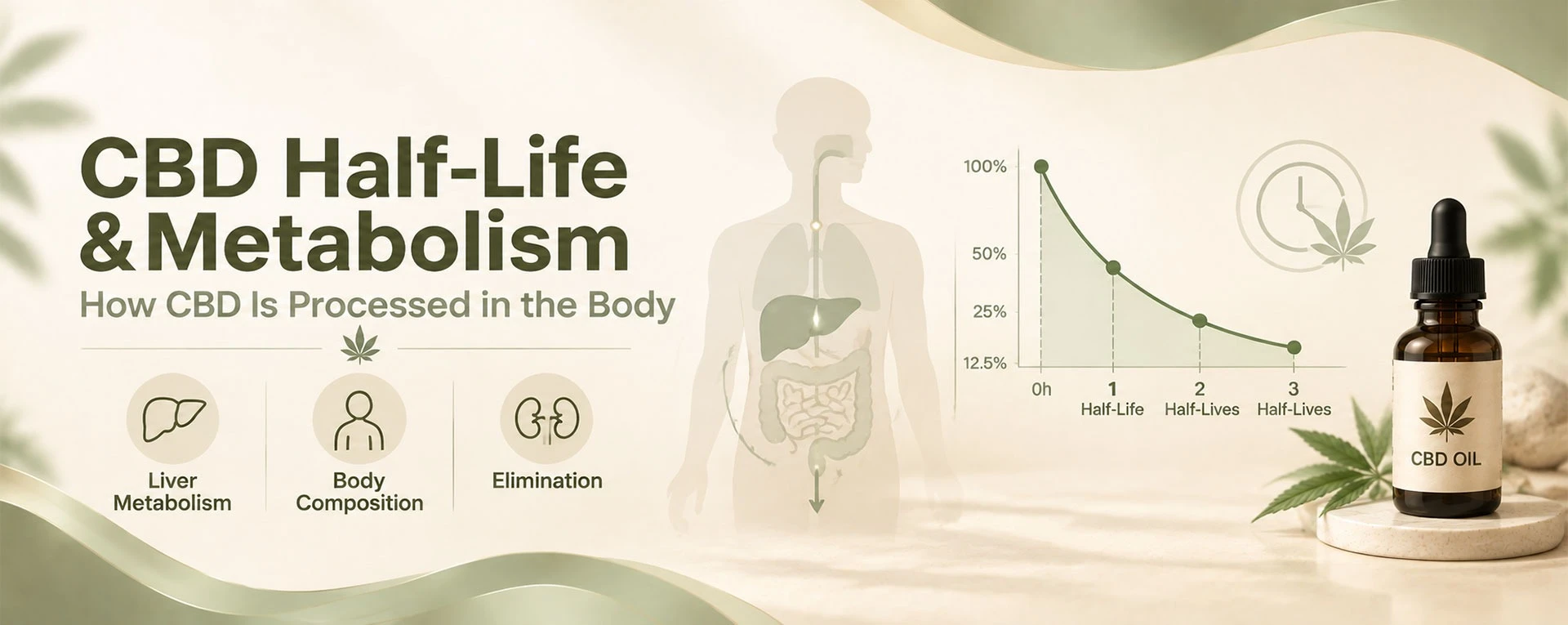
The CBD half-life is the estimated time required for the amount of CBD in the body to fall by half. It is not the same as the time required for every trace to disappear. A 2020 pharmacology review reports a terminal half-life of about 18 to 32 hours after a single exposure. With repeated use, estimates may extend to 2 to 5 days, depending on dose and individual metabolism. Treat these as population-level estimates, not a personal test prediction.
CBD metabolism begins after absorption. The liver processes CBD through enzyme pathways, including the cytochrome P450 family. CBD and its metabolites are then eliminated through the body’s normal waste pathways. Because CBD is fat-soluble, it may accumulate in fatty tissue and release slowly over time, particularly with repeated use. People with higher body fat percentages may therefore retain it longer, although body composition alone cannot predict a result.
Half-life math provides a scientific baseline, but it cannot predict a personal result. Dose, frequency, route of administration, body composition, liver function, food intake, and laboratory sensitivity all matter. Individual metabolic rates may clear CBD faster or slower. CBD can also interact with medicines and supplements, potentially changing their effects or CBD clearance, so ask a healthcare professional if you take other substances. The FDA notes that safety data for many retail products remain limited.
What affects the CBD detection window?
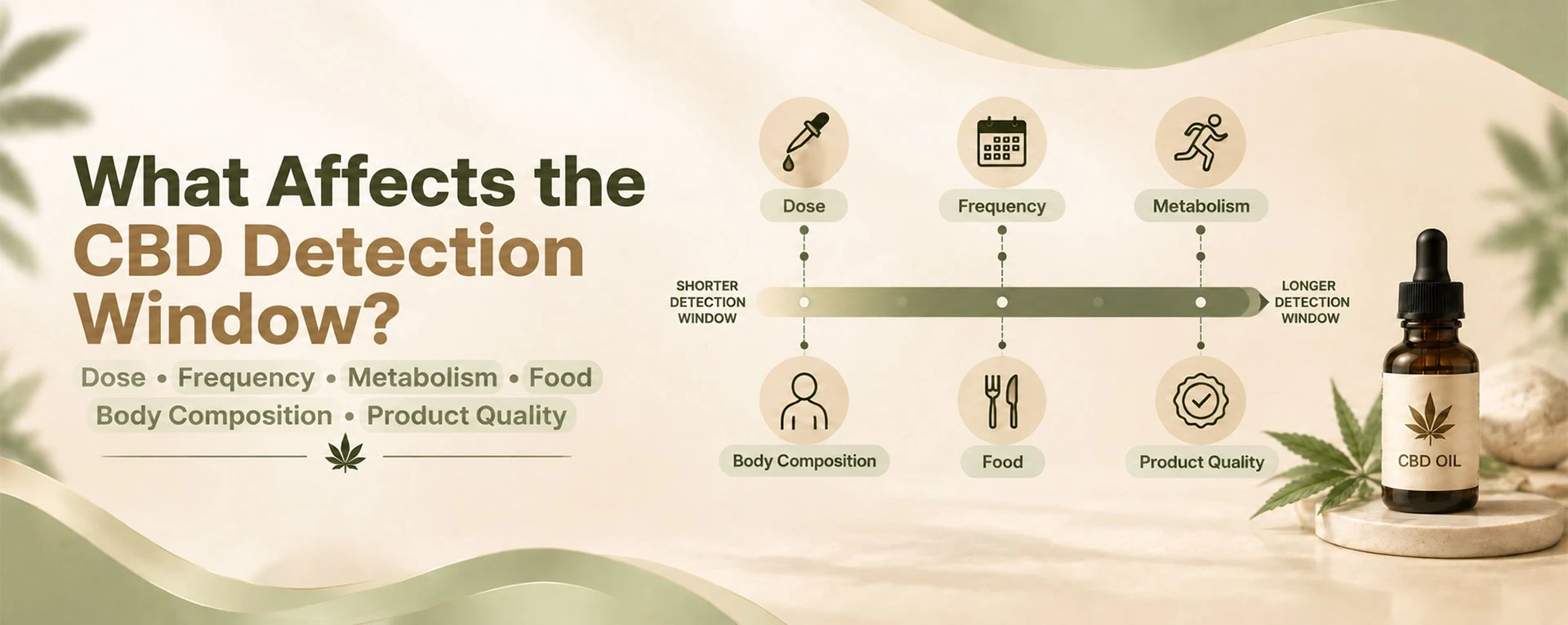
A person who uses a small amount once is not in the same situation as someone who takes a high serving every day. The most relevant factors include:
- Dose: Larger amounts create more CBD for the body to process and may extend the time before clearance.
- Frequency: Repeated use can create continued exposure. This is why chronic-use half-life estimates may reach 2 to 5 days.
- Product format: Inhaled products are absorbed quickly and often have shorter effects windows. Oral gummies and capsules move through digestion, usually producing slower onset and potentially longer retention. Sublingual oils may fall between those patterns. Topicals are intended for external use and generally create less systemic exposure, but no product should be assumed to be risk-free.
- Body composition: CBD is fat-soluble, so people with higher body fat percentages may experience longer retention as CBD accumulates in fatty tissue and is released gradually.
- Metabolism and liver function: Faster metabolic rates may clear CBD sooner, while slower rates, liver health, and individual enzyme activity can prolong its presence. CBD may also affect how some medicines work.
- Food: Taking oral CBD with food, especially a higher-fat meal, can change absorption. The effect is not identical for every product.
- Product quality: An inaccurate label, cross-contamination, or an unlisted THC ingredient can change the practical drug-testing risk.
CBD detection windows by test type
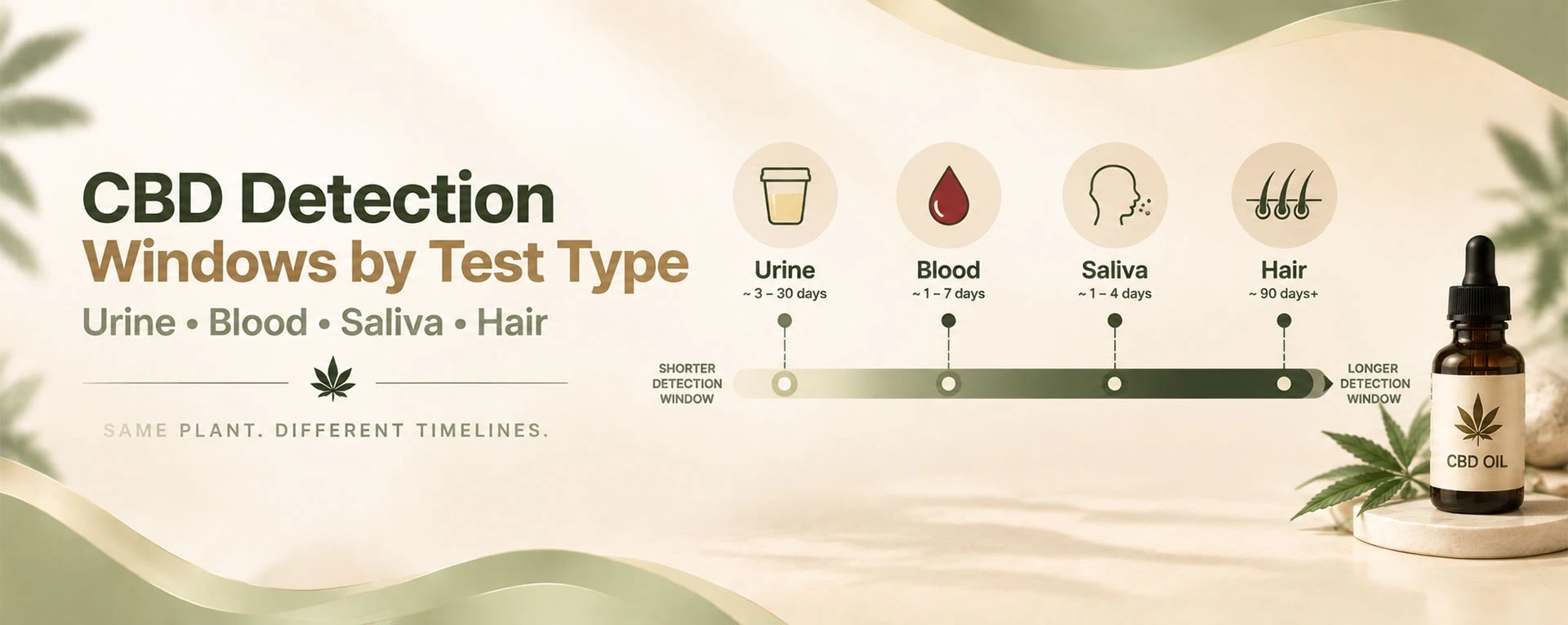
Urine
Urine testing is common in workplace screening and generally reflects prior exposure over days rather than how you feel at the moment. Published estimates place a CBD urine detection window at 3 to 7 days for occasional use and up to 30 days for frequent use. Those numbers are broad because they depend on dose, frequency, metabolism, and what the laboratory is actually measuring.
Many routine urine screens do not look for CBD. They usually target THC metabolites. A person can therefore be concerned about CBD while the practical test risk comes from trace THC in a full-spectrum product, a mislabeled formula, or contamination during manufacturing.
Blood
Blood generally has a shorter detection window than urine because it measures compounds circulating in the bloodstream. Published estimates place occasional-use detection at several hours to 1 or 2 days, with frequent use extending to as much as 1 week. Blood testing is less common for routine workplace screening but may be used in clinical, legal, or specialized settings.
Saliva
Saliva testing usually focuses on more recent exposure. The estimated window is up to 24 hours for occasional use and up to 72 hours for frequent use. Oral fluid results can be influenced by the substance tested, the collection method, and the laboratory’s threshold.
Hair
Hair testing can provide the longest lookback period. Published guidance commonly lists a window of up to 90 days. Hair analysis is not a perfect record of every use, and results can be affected by hair growth, sample characteristics, external contamination, and the specific laboratory method. Still, the longer lookback is why hair testing deserves separate consideration.
How long do CBD effects last?
CBD effects duration is usually much shorter than the time CBD or related compounds may remain measurable. Effects may last from a few hours to a day depending on the method, while fat-soluble CBD can remain longer as individual metabolic factors influence clearance. Feeling nothing does not prove that the compound has left the body. Onset and duration also vary by product, serving, food, and personal response.
| Method | Typical onset | Typical effects duration |
|---|---|---|
| Inhalation | About 1 to 5 minutes | About 1 to 3 hours |
| Oral gummies, capsules, or edibles | About 30 to 90 minutes | About 4 to 8 hours |
| Sublingual oils or tinctures | About 15 to 45 minutes | About 2 to 6 hours |
| Topical creams or balms | About 15 to 30 minutes | About 2 to 4 hours, localized |
These are practical ranges, not a dosage guide. Start with the product label’s directions and avoid taking more simply because an edible has not taken effect yet.
Can CBD cause a positive drug test?
Pure CBD is not the target in most standard THC drug screens. However, CBD products can still create testing risk when they contain THC. Full-spectrum products may legally contain up to 0.3% THC by dry weight, and regular use can increase cumulative exposure. Broad-spectrum products and isolates may reduce that risk, but “THC-free” should be verified through current, batch-specific testing whenever the result matters.
Before buying, compare:
- CBD per serving and total CBD in the package
- Full-spectrum, broad-spectrum, or isolate status
- THC results on a batch Certificate of Analysis
- Batch or lot number, report date, and laboratory name
- Other cannabinoids and added ingredients
Vibe District’s CBD collection makes it easier to compare formats, strengths, and product details. You can also browse CBD gummies or CBD oils and tinctures when you already know which format suits your routine.
How CBD product types compare
Format affects onset, effects duration, and what to check before buying. Use the comparison as a starting point.
| Format | Typical experience | What to check |
|---|---|---|
| Gummies or capsules | Pre-measured serving with slower onset | CBD per serving, THC profile, ingredients, batch COA |
| Oils or tinctures | Flexible serving and moderate onset | Dropper markings, CBD per serving, carrier oil, THC profile |
| Vape or inhaled CBD | Fast onset and shorter reported effects duration | Ingredients, cannabinoid profile, source, batch testing |
| Topical cream or roll-on | Localized use with less expected systemic exposure | CBD amount, application directions, complete ingredients |
When drug testing matters, choose the format and cannabinoid profile together. Browse CBD products available in store or ask the Vibe District team to help you compare the label details.
Can you flush CBD out of your system faster?
There is no proven shortcut that clears CBD or THC overnight. Drinking excessive water may dilute urine temporarily, but it does not remove cannabinoids and can create its own health risks. Detox drinks, herbal cleanses, intense exercise, and other quick-fix claims should be treated with skepticism.
Normal hydration, balanced nutrition, sleep, and regular activity support general health, but they do not override CBD half-life or guarantee a negative test. If a screening is important, the most reliable approach is to understand the employer or organization’s policy and allow adequate time rather than relying on a cleanse.
What this may look like in everyday situations
- One CBD gummy: Occasional use may be closer to the shorter urine range, but full-spectrum formulas add THC exposure.
- Daily CBD vaping: Frequent dosing can extend exposure even when each session feels short. Repeated-use half-life estimates reach 2 to 5 days.
- Choosing a topical: Topicals generally produce less systemic exposure than edibles, but still require label review.
- A required workplace test: Legal hemp status does not guarantee a negative THC test. Check the policy and batch COA.
CBD and drug testing in Florida
Hemp is generally defined at the federal level by a delta-9 THC concentration of no more than 0.3% by dry weight. That threshold addresses the legal classification of hemp, not a guarantee that a person will pass a drug test. Florida rules, product requirements, and employer policies can change or apply differently by situation, so confirm current requirements before using a cannabinoid product when testing has consequences.
For shoppers in Hallandale Beach and nearby South Florida communities, Vibe District offers a local way to compare CBD formats and ask label-focused questions. Visit the Hallandale Beach store or use the contact team to ask about current product details and availability.
Frequently asked questions
How long does CBD stay in your urine?
Reported estimates range from 3 to 7 days for occasional use and up to 30 days for frequent use. The actual result depends on dose, frequency, metabolism, body composition, product profile, laboratory method, and whether the test is looking for CBD or THC metabolites.
Does CBD show up on a drug test?
Most routine drug tests target THC rather than CBD. A CBD product can still create a positive THC result if it contains trace THC, is mislabeled, or is contaminated. Review the product’s current batch testing when testing risk matters.
Will CBD isolate cause me to fail a drug test?
Pure CBD isolate is not expected to trigger a THC test, but no retail label should be treated as an absolute guarantee without reliable batch testing. Check the Certificate of Analysis and the complete ingredient list.
Does the method of use affect how long CBD stays in your system?
Yes. Inhaled CBD is absorbed quickly, while oral products are processed through digestion and may have a longer onset. Topicals generally create less systemic exposure than products taken by mouth, although the formula and application area matter.
How long do the effects of CBD last?
Typical effects may last about 1 to 3 hours after inhalation, 4 to 8 hours after an edible, 2 to 6 hours after a sublingual product, and 2 to 4 hours locally after a topical. These ranges describe effects, not the full CBD detection window.
Can I speed up CBD clearance?
No method has been proven to remove CBD or THC from the body immediately. Normal hydration and healthy habits support the body’s regular processes, but detox products and extreme water intake cannot guarantee a negative test.
The bottom line
So, how long does CBD stay in your system? A single dose may have an 18 to 32 hour half-life, while repeated use may extend that estimate to 2 to 5 days. Approximate detection ranges reach 3 to 30 days in urine, up to 1 week in blood, up to 72 hours in saliva, and up to 90 days in hair. These numbers are useful for planning, but they are not personal guarantees.
The most practical step is to choose products with transparent labels and accessible batch testing. Explore CBD products at Vibe District, compare oils and tinctures, or visit the Hallandale Beach store for help understanding product format and cannabinoid profile.
Sources and evidence
Detection and half-life ranges are summarized from pharmacokinetic literature and testing guidance, including the 2020 review Pharmacology and legal status of cannabidiol. For consumer safety and regulatory context, review the CDC overview of CBD and FDA guidance.